
The Overcorrection Trap in Relationships
The psychology of overcorrection and the unintended consequences of trying too hard

Relationships are hard. There are always challenges, disagreements, and transitions that demand attention and adaptation. Even when both people are committed to the relationship and determined to find a solution, challenges still occur. While each partner might use a different strategy — addressing it head on or pretending that nothing has happened — both are aware of the problem and want to correct it. In the process , they apply strategies with a solution that swings too far in the opposite direction.
This is overcorrection — when a disproportionate, rigid, or limited strategy is used to rectify an unwanted pattern. While I’ve written before about the cultural overcorrection toward self-focused, individualistic trends, the overcorrection cycle is also common at the individual level.

The relationship cycle of overcorrection
Overcorrection occurs when we apply a rigid, narrow solution to a complex relational problem in an attempt to reduce distress and regain control. Instead of restoring balance, the solution pushes the relationship into a new imbalance.
The cycle of overcorrection in a relationship follows a predictable sequence:
Problem/unpleasant pattern → Strong corrective solution is introduced → Temporary relief → The solution is difficult to sustain → The correction creates a new problem or reemerges.
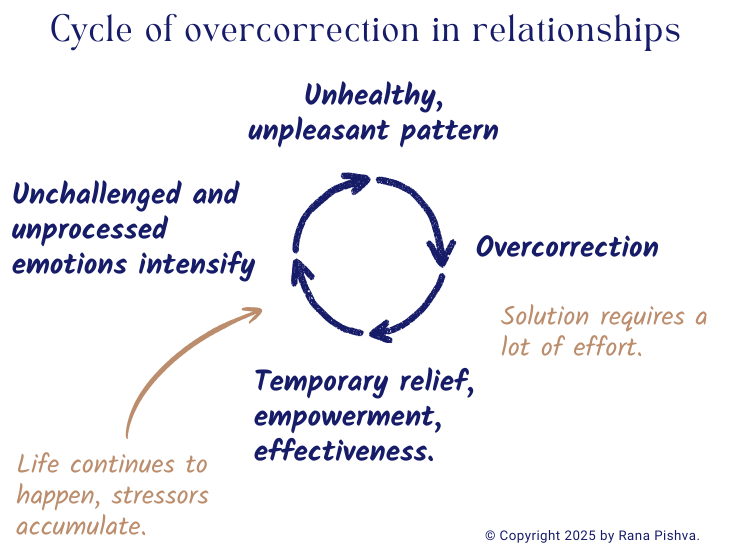
The relationship swings between extremes: periods of calm and attunement and periods of disconnection and frustration.
Note that I am not referring to a cycle of abuse, where the abuser manipulates the victim with attention, affection, and gifts in a calm, conflict-free period that is inevitably followed by another period of abuse. This is a distinct, one-sided, manipulative pattern.
Here, I am describing a more common ebb and flow in relationships, where similar conflicts arise, the solution is disproportionate, and while it may be effective for some time, it will strain and collapse again. In this situation, both individuals in the partnership are well-intentioned. They want the relationship to improve. The challenge they face is reactive correction, rather than the conflict itself, or the motivation for growth.
Consider a couple that “doesn’t fight” — not because they are a perfect match or incredibly reasonable, but rather because they avoid it. When the tension inevitably boils over, they take the opposite strategy and decide, “We need to communicate about everything.” So they have a weekly relationship meeting, unpack every interaction, process each feeling, and even revisit previous disagreements. What started as a correction — more communication — turns into constant emotional processing and exhaustion.
Or consider when a person realizes they have been overly accommodating. A “people pleaser” who is continuously “fawning”. They rarely say no. They sacrifice their needs to keep the peace. Eventually, they read a book, listen to a podcast, and decide that something must change. The boundaries they set are abrupt: they decline requests without discussion, cut off people who are not in agreement or who challenge them, and frame compromises as “fawning” and self-abandonment. Here, the attempt at healthy self-advocacy has turned into rigidity and self-isolation.
Why we overcorrect in relationships
Overcorrection happens when we attempt to eliminate the original problem entirely and take drastic action without first understanding the events and emotions that it has elicited. Avoidance of conflict is addressed with over-analysis, self-sacrifice with unapologetic self-protection (I’m talking to you, “Let Them” theory), and enmeshment is replaced with isolation and disengagement.
The process is rarely malicious. It is usually driven by a desire to repair harm and prevent future pain. The pattern repeats for specific reasons. First, painful experiences activate defensive, survival responses. When people feel hurt or ashamed, they search for solutions that eliminate vulnerability and reestablish safety. To do this, they choose a habitable, familiar, and simple solution. Let’s talk about everything. Set rigid boundaries. Protect your peace.
Second, certainty feels safer than ambiguity. Clear rules — never trust again, always speak up, never compromise — provide a sense of clarity and control. This is why self-help books with simple, actionable steps are popular (“just let them!”). Finally, dramatic transformations are praised in our culture, whereas subtle, gradual changes are underestimated or not seen as valuable. Change is framed as decisive and absolute, rather than gradual and nuanced. The expectation of meaningful change, followed by swift action , leads to a temporary sense of empowerment and relief. Unfortunately, it is unsustainable and susceptible to other stressors.
A couple who has agreed to “talk about everything” might not be able to uphold that across every aspect of their lives. Someone who is “protecting their peace” will likely feel conflicted when a close friend’s birthday overlaps with an evening pre-scheduled for self-care time. Competing values, daily stressors, and our tendency to take the path of least resistance push us back to old patterns.
You can also spot overcorrection when the decision is made out of anger or another intense emotion , or when absolutist language is used.
“From now on, I’m not doing that anymore.”
“I refuse to tolerate anything like this again.”
“We need to talk about all our expenditures.”
Decisions made from anger are focused on regaining control and a sense of safety, not on fostering connection and interpersonal security.
Relationships are complex — and one change will often initiate others, although not always in the preferred or intended direction. One person may overcorrect with the hope that the other person will change. While this might be the case initially, changes that are motivated solely by external factors are often short-lived and unsustainable. Life happens, and old habits resurface when our limited resources are strained by daily stressors.
The most telling sign that overcorrection is occurring is that new problems arise after the “fix”. There is more frustration, disappointment, and conflict. The problem reemerges, even if it is in a slightly different form.
What to do about it
Once you notice overcorrection, you have the opportunity to course correct. And while the temptation can be to instill a new overcorrective measure, or to tweak the current solution to the new problem — this can lead to another facet of overcorrection: compounding fixes. Having an excessive number of solutions gradually added onto to each other, leaves turns the problem as a bigger mess. The problem becomes overengineered, and you’ve lost sight of the core issue (“what are we fighting about again?”).
You might decide to do nothing at all. And while radical acceptance is necessary in most relationships, some issues are too persistent or recurring to be brushed off or ignored.
Since overcorrection stems from a fear of repeating an unhealthy pattern and wanting prevention at all costs, the solution is to set a new object. To ask a different question.
Overcorrection happens when we ask “how can we get rid of this problem” instead of “how can we manage this sustainably?”
How?
Understand it from all the angles: why is this issue so important to you? Is this about power, wanting to be seen and validated, or reassurance against your fear of abandonment? Get deep and uncomfortable to reveal what the disagreement is actually about.
It can help to break the issue down into triggers, your reaction to it, and the function. Ask yourself:
What gets this problem going? (trigger)
How do I respond to this - name thoughts, feelings, urges)
What am I trying to accomplish? (be heard? respected? reassured?)
Then focus on the long-term goal for this relationship: what will this “problem” look like in 5 years? It is unlikely to have disappeared, but perhaps it’s something that you can chuckle at, or one that you can respond to with compassion rather than anger.
Of course, having an open dialogue with the other person in the relationship will help answer these questions and evaluate the outcomes and goals more realistically.
Overcorrection can seem inevitable, because it is rooted in our instinct to seek and maintain safety. Intentional evaluation of the problem, values, the function of the reactions, and goals for the relationship can help focus on addressing the right problem, without using overly broad, drastic, or reactive solutions that could ultimately be harmful.
Hi, I’m Dr. Rana.
I’m a clinical psychologist, specializing in attachment, trauma, and life transitions. I’m passionate about supporting mental health professionals strengthen their clinical skills, and helping people make sense of their stories.
If you’d like to learn more about my clinical and consultation work, visit Sorted‑Mind.com, where you’ll find resources, workshop details, and more ways to connect with me directly.